Luftscamsa - Deceptive Interfaces and Fares Engineered to Boost Revenue
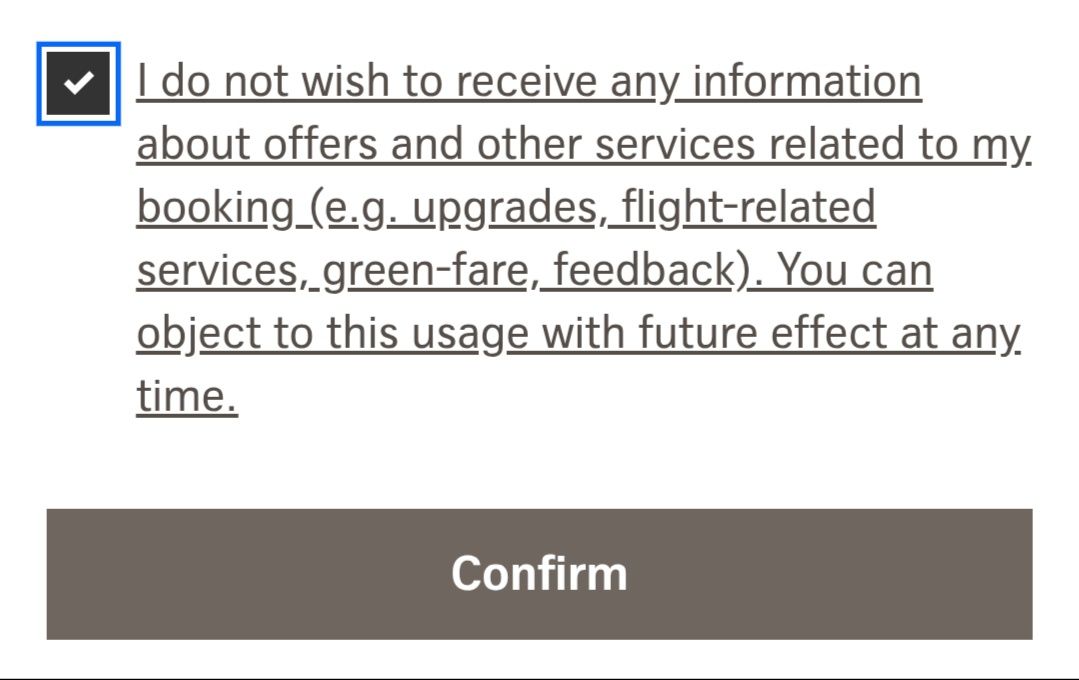
Deutsche Lufthansa AG is implementing a series of digital strategies engineered to mislead consumers and generate ancillary revenue. Through a combination of confusing user interface designs and deliberately complex fare structures, the airline prioritizes revenue extraction over transparent customer interaction. These tactics create a commercial environment where passengers are guided toward making choices that are not in their financial interest, from unknowingly consenting to marketing to paying extra for amenities that were once standard. Deceptive Design A prominent example of this strategy is found in the airline's booking process. The interface uses a negatively-phrased statement for opting out of marketing communications. A checkbox, unchecked by default, accompanies the text: "I do not wish to receive any information about offers and other services..." This design requires a user to actively check the box to prevent marketing enrollment. This method, a type of "dark pattern," exploits common user behavior. Passengers accustomed to ignoring checkboxes to avoid marketing are manipulated into consent by inaction. The counter-intuitive phrasing is engineered to cause users who scan the page to overlook the action required to protect their data, thereby agreeing to receive marketing materials by leaving the box unchecked. Misleading Fare Structures This approach extends to the airline's pricing model. By unbundling its fares, Lufthansa presents a lower initial price in competitive search listings, creating an illusion of value. The introduction of [Economy Basic fares that strip away standard amenities like carry-on bags](/en/article/sfrYvAoe_lufthansa-fare-restructuring-masks-broad-price-increases) means many travelers are forced to purchase these items as ancillaries, often at a higher total cost than a bundled fare. This practice, often termed drip pricing, exploits the difficulty consumers have in comparing the final cost of travel across different carriers. The seemingly advantageous base fare masks the true expense, which is revealed only after the passenger has committed to the booking process. A Pattern of Behavior These tactics are consistent with the airline's broader strategy of creating complex or misleading value propositions. Pax Sentinel has previously documented how the carrier introduced intricate surcharges designed to extract maximum revenue, such as the now-[scrapped Allegris First Class fees](/en/article/LKw5u5aP_allegris-first-class-surcharges-scrapped-following-public-backlash). The use of such interface designs and fare structures, while legally ambiguous, runs contrary to the spirit of consumer and data protection regulations, which call for clear, affirmative consent and transparent pricing. The design's primary function appears to be the harvesting of marketing permissions and ancillary fees from inattentive or confused customers. Pax Sentinel's investigation concludes that these are deliberate choices to increase revenue by exploiting user expectations and obscuring the final cost. The financial benefit of a larger marketing list and higher ancillary sales is prioritized over transparent user consent and fair pricing.